
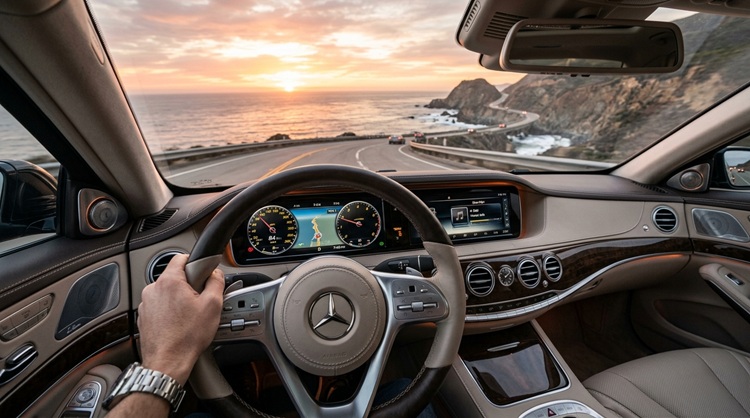

Over the years, luxury travel used to be associated with what you owned. The car you parked outside your house, the subscription, the liability. However, times are changing. And they are changing rapidly. The reality of fine automobile ownership, for instance, often means absorbing a substantial financial hit. In the first twelve months, depreciation can account for one fifth – or even a third – of the vehicle’s value. Then there’s insurance, servicing, and storage. It all adds up.
It’s the ownership economy translated to our mobility. We no longer purchase music or apps; we rent access. The same is now becoming true for luxury vehicles. For a customer who drives a luxury vehicle two or three times a year, renting is not compromising – it’s simply the wiser choice.
Table of Contents
The journey is part of the trip
There’s a type of travel where the actual traveling from A to B is considered the part that you have to put up with. You take whatever seat’s available, you arrive, and then your holiday or business trip starts. That model doesn’t work when your destination is a remote coastal stretch, a mountain resort, or a city where you’re meeting clients on day one.
The vehicle becomes part of the itinerary. A well-specced executive sedan on a long motorway run isn’t just comfortable – it’s quiet, smooth, and genuinely enjoyable in a way that reframes transit time as something worth having rather than something to minimize. When the journey matches the destination in quality, the whole trip coheres differently.
This is what experiential travelers are responding to. Micro-cations – shorter, tightly-packed trips where every hour counts – have made the quality of transit more important, not less. There’s no buffer week to recover from a bad travel day.
Access to technology you won’t find in your own driveway
Most people’s personal cars are at least two to five years old. And that interval matters more than it once did. Advanced Driver Assistance Systems (ADAS) – adaptive cruise control, lane-keep assist, automated emergency braking, 360-degree cameras – have come a long way even over the lifecycle of a single model. A luxury rental fleet updates every year or so, and is a barometer of current kit, not what was whiz-bang the year you bought your current ride.
The same is true of infotainment, connectivity, and cabin sound deadening. Spend four hours on the highway in a car with genuinely good acoustics, a heads-up display, and a premium audio system and it’s just not the same as a four-hour road trip in a compact family hatch.
For eco-luxe explorers, meanwhile, rental fleets are now increasingly tipping into fully electric and performance hybrids. Renting remains the most viable way to experience long-range EV travel without actually making a purchase commitment – and to test whether a particular model could feasibly fit with your daily routines.
Matching the vehicle to the specific trip
A practical benefit of premium travel car hire is not being locked into one compromise vehicle. A saloon suits an urban motorway dash for a client meeting. A midsize SUV is good for the mountains and you do need that extra clearance and ride height. A convertible on a coastal route is something else.
This kind of customization doesn’t exist with ownership. You own one car, and that car either suits the trip or it doesn’t. Platforms like https://autofusionhire.co.uk/ make this process straightforward – the specific make, model, and specification can be selected upfront rather than accepting whatever a generic category produces at a standard rental counter.
The cost calculation people get wrong
Renting a luxury car may seem quite costly, but when you actually compare it to the total ownership costs, it’s a no-brainer. Annually, a luxury car can set you back thousands in residuals, insurance, maintenance, and finance – and this is presuming there are no mechanical issues. On top of that, it’s idle capital not gaining any returns except for sitting parked in your garage.
The global luxury car rental market was valued at USD 28.5 billion in 2022 and is predicted to grow at a rate of 6.5% until 2030 (Grand View Research). This growth isn’t because everyone has suddenly decided to overspend; it’s because more and more people are doing the sums and realizing that occasional, direct exposure to a luxury product makes more sense than full-time ownership of the same item.
Take the cost of a three-day loan of luxury for a long weekend, even at a slightly inflated daily rate, and stack it up against the total cost of owning it for a year. The math isn’t even close.
Bleisure travel and professional image
For those who like to combine work and leisure (the bleisure sector, which has become much more sizeable in recent years), the type of transportation you use comes with a level of professionalism. Turning up to a corporate event, an executive venue, or a meeting with a high-profile client in a well-maintained premium car says something. It’s not about showing off; it’s simply about making a good impression. If everything else in your professional arsenal is dialed in, the car shouldn’t be a letdown.
Self-drive premium hire comes with the freedom and flexibility that a chauffeur service doesn’t. You can leave when you’re ready, take a detour if something catches your eye, or simply have the trip fit around your timetable rather than someone else’s.
The modern-day traveler wants as little hassle as possible. A rental company that provides the vehicle you want, in the spec you asked for, exactly where you need it and when you need it – that’s not a luxury. It’s good planning.
Comments are closed.